
Portakabin
UK  Ireland  België  Belgique  France  Nederland  Gulf region  Site map
Environmental BenefitsEnvironmental CredentialsGreen Design OptionsSustainable ProcurementWaste ManagementSustainability Summary

Sustainable Procurement


The issue of sustainability is growing ever more important and construction has perhaps the greatest impact than any other sector or activity. This report looks at how off-site building methods can help you procure and deliver more sustainable buildings and minimise impact on the environment. It also offers some practical tips for assessing the environmental performance of your modular specialist or building contractor.

Why is Sustainability Increasing in Importance?


New legislation is forcing construction clients, designers and contractors to adopt a more sustainable approach, and interest from the wider public and pressure groups is adding to the drive for change. The reasons for this change have been widely publicised - the world's diminishing natural resources, and the acceleration and dangerous effect of global warming.


The Government has committed to making all its estate carbon neutral by 2012. Inefficient buildings are responsible for half of the UK's carbon emissions, which the Government has pledged to reduce by 20 per cent by 2010 and 60 per cent by 2050.


When designing for sustainability, the most easily understood objective is to reduce and conserve the energy consumed in a building, which has a direct technological response. However, what constitutes sustainable development should also include the construction site as a consumer of resources. Consideration has to be given to:


  • orientation
  • material selection
  • the building process
  • a long-term strategy for energy consumption.


Until now, there has been little evidence to prove the case that off-site construction is a more sustainable method of delivering high quality permanent buildings.

This report examines this issue and the associated benefits of building off site, to assist you in selecting the most appropriate building solution for your organisation. 
 

Specification Decisions to Help Reduce Carbon Emissions


1.  Air Leakage


Air leaking in and out of any building, greatly inhibits the energy efficiency of its structure and easily undermines the best thermal insulation. By minimising air leakage in a building, a warm, draught-free internal environment is delivered, with lower running costs, reduced capital equipment costs and reductions in carbon emissions.


Full-scale independent tests for air permeability have shown that modular buildings can consistently perform up to 70 per cent better than traditional site-based construction*.


Air pressure tests carried out on a range of completed buildings in accordance with Building Regulations Part L2A have demonstrated how steel-framed modular technology can achieve a higher degree of precision, leading to improved thermal efficiency, lower running costs and reduced carbon emissions.


2. The Building Process


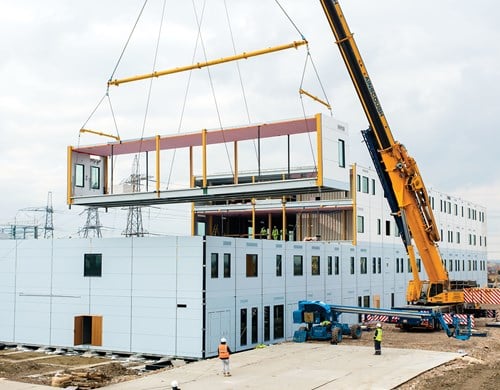
Modular buildings are factory-built off site to quality-controlled standards, using highly trained operatives and a high degree of repeatability.


There are no wet trades so shrinkage and structural movement after the building has been sited are also highly unlikely. These factors mean that modular buildings can perform well in excess of the minimum standards set out in the Building Regulations* - a significant environmental benefit.  
 

3.  The Type of Building System


Steel-framed modular systems can minimise thermal bridges and make buildings easier to heat.


A composite panel construction can ensure continuity of insulation across the building envelope and that there are none of the cavities associated with loose-fill insulation. This reduces the risk of condensation, which can affect the thermal effectiveness of a building.  


4.  The Impact of the Construction Method on the Environment


It has been claimed that up to 67 per cent less energy is required to produce a modular building compared to an equivalent traditionally built project (source: Arup Research and Development).


5. Transportation


Off-site construction can generate up to 90 per cent fewer vehicle movements to site (source: Mtech), which offers clear environmental benefits, as well as reducing congestion and disruption during construction.


6. How can Waste be Minimised?


 Pressure is increasing on the construction industry to halve the amount of material waste going to landfill in the next six years. The Waste and Resources Action Programme (WRAP) states that UK construction consumes more than 400m tonnes of materials each year, generating 100m tonnes of waste.


Research carried out by WRAP has also stated that off-site construction generates up to 80 per cent less waste compared to site-based building methods. This is because much of the work takes place in a controlled factory environment, which makes waste segregation and recycling much easier.


Good design and engineering waste-generating operations out of the manufacturing process are key. Examples include:


  • Intelligent modular design, which maximises the use of standard width materials and minimises the amount of cutting to fit.
  • Door and window cut outs from insulated wall panels, which can be re-used in other modular products*
  • Value engineering the composition of polyurethane insulating foam can result in a 10 per cent reduction in material consumption*
  • Steel beams can be supplied to the factory in the precise length required for a specific module size, eliminating the need for disposing of off-cuts
  • Particle board used for floors can be pre-sized for the modules, removing the need for trimming to size and particle board waste. The working environment in the factory is also then greatly improved as there are no wood particles or dust generated.


A modular system can incorporate a base that is integral to the module and therefore requires simplified foundations. This in turn reduces the amount of waste sent to landfill or for redistribution on each site.


In order to reduce waste in the modular manufacturing process, suppliers of low value, high volume materials, such as adhesives and fastenings, can deliver direct to the production line. This eliminates any packaging that would otherwise need to be disposed of. Wood chips generated in the joinery operations can be collected and sold.


7.  Factory versus Work on Site  


A factory has a better infrastructure than a construction site. It can be equipped with extensive lifting facilities, for example, allowing materials to be handled in larger and more appropriate sizes than on a building site. Advanced CNC cutting machines can be used in the production of steel and timber module components, improving accuracy and further reducing waste.


Conditions in the factory are significantly improved compared to a building site that is exposed to the elements. Skilled staff work at a constant temperature of around 16 degrees*, without being encumbered by heavy clothing, which helps to ensure consistently high build quality. On a building site, operatives can get wet and cold, which decreases their dexterity and has a negative impact on material wastage, product damage and segregation for recycling.


The volume of material wasted through damage and deterioration is also significantly reduced with off-site construction. Any storage is under cover and in controlled factory conditions, and operatives are not subcontracted labour but are permanently employed and highly skilled and trained.  


8. How Much Waste is Recycled?


Staff training and instilling the discipline to recycle is key and should be ongoing in order to maintain the waste streams.


In a controlled factory environment, segregation for recycling at source, using colour-coded skips, is much easier than on a building site.


Materials such as plastic, cardboard, polythene, timber and paper can be segregated for recycling and pallets used throughout the manufacturing process should all recycled through the supply chain.


9.  How is Whole Life Costing Used?


Whole life costing is now a requirement for all public sector building contracts, and PFI and PPP schemes. It is also central to sustainable development.


The use of advanced building simulation software can allow a detailed environmental analysis to be carried out for every project at the earliest design stage. This is a powerful tool that can assess the impact of specification decisions on capital cost, energy consumption, carbon emissions and running costs over the life cycle of a building to produce the most sustainable design solution for each project.


The software can prevent over-specification of M&E plant and facilitate compliance with Building Regulations. It can also generate valuable data on annual carbon emissions, heating and cooling costs per square metre, whole life costing, energy audits and air quality by individual room, ensuring a pleasant internal environment.


How to Assess the Environmental Performance of a Modular Manufacturer or Contractor


The demand for off-site construction continues to increase in every sector, and consequently, there are a greater number of specialist contractors than ever before. It is therefore critical in the selection of a modular partner, that construction clients compare manufacturers, contractors and systems that are like for like.


Construction clients should now be looking closely at contractors' policies on sustainability, as well as factors such as: 


  • track record in your sector
  • statistics for repeat business
  • the number of projects delivered on time and on budget
  • health and safety record.


Key Factors to Consider 


  • Does the contractor have an ongoing commitment and policy on sustainability?
  • Are they working in line with the Sustainability Charter issued by the Major Contractors Group?
  • Can the manufacturer or contractor demonstrate ongoing reductions in waste and carbon emissions generated in the production process? What are the figures for each?
  • What percentage of waste is recycled?
  • What energy saving targets are in place?
  • What is the contractor's approach to the design of sustainable buildings?
  • What inhouse capability do they have to value engineer the building design for maximum energy efficiency?
  • How does the building system perform in areas such as air permeability and ventilation to meet Building Regulations Part L2A and Part F? Look closely at the test results achieved for completed buildings.
  • Is the contractor actively looking at low or zero carbon technology to further enhance the environmental performance of its buildings?


Adopting a more sustainable approach to construction does not have to increase costs but it can add considerable value to a building project. And the use of modern methods of construction, such as modular building systems, can help clients, contractors and architects achieve their sustainability objectives with all the other speed, quality and efficiency benefits associated with off-site construction. 


Do you want to save money on your energy bills and reduce your carbon footprint?  Click here for information on Titan Solar - the first solar-powered relocatable building!


*These statistics are based on the Portakabin steel-framed modular building system.


© Portakabin 2010   |   Portakabin Head Office, Huntington, York, YO32 9PT   |   Tel: Sales: 0845 401 0020 Hire: 0845 401 0010
Porta, Portakabin, Pacemaker, Pullman, Titan, Titan Building System, Portakabin Solus, Ultima, Ultima Vision, Duplex, Portastor, Portaloo, Portaloo Junior, Lilliput, Lilliput Children's Centres, Lilliput Nurseries, Portakabin AirCare, Portakabin Access, Portakabin Interiors, Portakabin Protecta, Portakabin Total Solutions, Portakabin Events and Portakabin FireSafe are trade marks.